Author: Leaetta Hough, PhD, June, 2026
Executive Summary
The beneficial effects of trees on the environment, property values, and the physical and psychological health of people are well known and scientifically documented.1 The proposed raised, separated bike trail, the Summit Avenue Regional Trail (SART), requires a full reconstruction of Summit Avenue which will impose substantial environmental, health and financial costs on the City of Saint Paul and its residents. Full reconstruction of the avenue will result in the loss of a massive number of mature trees – assets that function as critical environmental infrastructure and are central to the historic character of Summit Avenue. Analyses in the report draw on arborist assessments, municipal documents, scholarly research, and literature searches guided by AI, to estimate the magnitude of these losses.
Mature trees provide disproportionately large ecological and health benefits, yet they are also the most vulnerable to construction impacts, especially when their critical root zones are disturbed. Even minimal incursion into the root structure of mature trees is detrimental to their longevity, and damage from construction more than doubles the likelihood of tree failure during windstorms. Because Minnesota regularly experiences gusts exceeding 30–40 mph, the risk of widespread canopy loss is high. Although the City assumed that “only” 221 of 1,561 trees (14%) would be lost, this was based only on an average from previous road reconstruction projects. It fails to factor in the impacts directly associated with building the raised, separated trail including moving all curbs, rebuilding driveways and planned path cuts across boulevards to intersections. This substantially underestimates the level of destruction that will occur. The age of the canopy and well‑established arboricultural “rules of thumb” indicating low tolerance for root disturbance also compel a more realistic assessment of the actual impacts. Even the City’s own experts recognized the greater magnitude of the loss in earlier versions of the proposed bike trail. Their conclusions ruled out as NOT RECOMMENDED (caps original) the design now being proposed because of its impact on the boulevards containing the existing tree canopy.
The financial consequences for property owners and the City are significant. Research consistently shows that tree loss reduces home values. A 7% loss in tree canopy cover results in 7% loss in property value, and even a single mature tree can influence value by 3–15%. Using the City’s conservative estimate of 14% canopy loss would reduce Summit Avenue property values by $56 million, or roughly $100,000 per taxable property. These losses are compounded by the City’s anticipated assessment of approximately $30,000 per property for reconstruction costs. Assuming residents challenge both the assessment and the City’s refusal to reflect the loss in value of their property resulting from the construction of the bike trail, the City could be facing an annual loss of tax revenues of somewhere between $350,000 and $700,000, or even more.
Environmental and public‑health impacts further amplify the cost. Mature trees remove 20–50 pounds of CO₂ annually, filter pollutants, cool air temperatures, reduce stormwater runoff, reduce noise, and mitigate urban heat island effects. Two to four mature leafy trees produce as much oxygen as one person needs in a year. The psychological and physical health benefits are equally well‑documented: reduced cardiovascular disease, lower rates of mood disorders, improved sleep, and decreased mortality from respiratory and cardiac conditions. These effects are supported by multiple peer‑reviewed studies.
Finally, the destruction of Summit Avenue’s historic canopy irreversibly robs the avenue of its identity as “the best-preserved avenue of Victorian architecture in the country.” Bolton & Menk describe the trees on Summit Avenue as a ‘character defining element’ for the historic district. Widespread tree loss and the introduction of a raised, separated bike path will destroy its historic integrity, reduce tourism appeal, and undermine the City’s broader goals of making Saint Paul a destination city.
The proposed full reconstruction of Summit Avenue will impose substantial and long‑lasting costs on property owners, the City, the environment, and public health. It raises serious questions about the value and justification of the project as currently proposed. The City needs to prioritize preservation of the existing tree canopy and pursue less destructive design alternatives that protect the environment, the physical and psychological health of citizens, property values, and the historic character of one of the City’s most valuable corridors.
Full Report
The beneficial effects of trees on the environment, property values, and the physical and psychological health of people are well known and, as described below, supported by scientific evidence. Among forestry scholars, arborists, and environmentalists, trees are considered superheroes and need to be preserved.
The construction of the City of Saint Paul’s proposed Summit Avenue Regional Trail (SART) as envisioned in its 2023 plan will impose extraordinary costs, hard and soft, on the City of Saint Paul and its citizens. The City has accelerated the plan to reconstruct all of Summit Avenue so it can build a separate, off-street, raised bike path. This would require the City to move all the curbs on Summit Avenue, many of which are historic granite, and decimate the root structure of the trees that currently provide Summit with its iconic canopy. The City hired Bolton & Menk, an engineering, design, and planning firm, to consult on the project. They specifically stated that to protect trees and preserve historic integrity, none of the curbs should be moved. If the City moves forward with its proposed plan, the City and its citizens will suffer serious and irreversible consequences to the environment, property values, and health of the citizens.
Analyses described below document the magnitude of the losses due to destruction of trees that will have to be sacrificed to build a raised, separated bike trail and force a premature full reconstruction of Summit Avenue.2 The analyses described require an estimate of the number of trees lost, a definition of a mature tree, a summation of property values along Summit Avenue, and the number of properties (excluding religious structures and academic institutions, i.e., non-profit organizations). The data for these analyses were obtained from arborists reports, City documents, scholarly research, and literature searches including material gathered by Google Gemini and Microsoft Copilot. The results are organized according to:
- Data Required.
- Effect on Summit Avenue Property Values Due to Tree Loss.
- Effect on Environment and Human Health Due to Tree Loss.
- Effect on Historic Character of Summit Avenue.
- Final Thoughts.
I. Data Required
When calculating the value of tree loss to a city and its citizens, several factors are important. Those factors are:
- Number of mature trees that are expected to be lost. This includes not only the number of trees that are cut down during construction but also the number of trees that are likely to be lost within a few years due to construction encroaching into the critical root zones of the trees.
- The total number of trees on Summit Avenue. • Frequency and speed of windstorms and gusts that are likely to topple mature trees whose root structures have been compromised due to construction encroaching into their critical root zone.
- Total number of physical structures involved, as well as the total number of structures that do not pay property taxes (e.g., non-profits such as religious organizations and academic institutions) and the total number of structures for which property taxes are levied.
- Value of the physical structures for which property taxes are levied.
- Amount of carbon and other pollutants that a mature tree removes as well as the amount of oxygen not created when a mature tree is lost.
- Amount of cooling (and heat loss prevented) provided by the tree canopy which shades the surrounding area (and wind reduction in winter months that prevents heat loss).
Data and information for these factors are available through literature research and other sources. Many of these factors are known, can be calculated, and/or can be estimated with a reasonable amount of confidence.
There are other costs related to loss of trees that we do not estimate because we do not have solid information to do so. For example,
- Cost of power outages caused by compromised trees falling during storms and damaging utilities.
- Cost of storm sewers and basements flooding because of loss of tree roots that capture rainwater.
- Cost of lost tourism because the avenue that the American Planning Association named as one of the ten “Great Streets in the U.S.” and the “best preserved avenue of Victorian architecture in the country”3 will have lost that distinction. The avenue will be without many if not most of its trees, and the addition of a separated, raised bike path will be historically incorrect. Summit Avenue will have lost its historic value and beauty.4
The cost of these we leave to others to estimate.
Below are the data found and used to calculate cost estimates associated with the loss of trees on Summit Avenue due to the City’s proposed reconstruction of Summit Avenue that includes a separate, raised bike path.
Estimating the Number of Mature Trees Likely to be Lost
Definition of a mature tree. Different definitions for different purposes and constituencies exist. Foresters generally use ecological or biological definitions. Legal and regulatory definitions typically found in municipal tree ordinances and preservation acts rely on the Diameter at Breast Height (DBH) to provide clear, enforceable standards for permits and fines. DBH is the diameter of the tree measured at 4.5 feet above the base, i.e., breast height.5 The diameter used varies, but AI searches indicate that a range of 6-12 inches is typical for
municipal ordinances.
Diameter, i.e., the distance around the tree trunk, is easily converted to circumference. Tree circumference, the distance around the tree trunk, is a metric that is most readily available to determine the maturity of a tree. The algebraic formula for calculating circumference when the diameter is known is:
Diameter = Circumference
π
Where π = 3.14.
Using this formula a tree diameter of 12 inches equals a circumference of 37.68 inches, and a diameter of 6 inches equals a 18.84-inch circumference. Using a diameter of 9 inches, which is the midpoint between 6 and 12 inches, equals a 28.26-inch circumference. Rounding
down, 28 inches at DBH is the approximate circumference of a mature tree in many tree ordinances and preservation acts. Definition and importance of critical root zone and structural root plate. The critical root zone is the area beneath the tree where roots essential for the health and structural stability of the tree are located. It can be visualized as a circle around the tree trunk that has as its radius
at least one foot for each one inch of the diameter of the tree trunk measured at DBH. The structural root plate is an area of significant tapering from the base of the tree trunk outward away from the trunk and includes the structural root system of the tree. The size of the structural root plate is proportional to the diameter of the tree measured at breast height, DBH, as well as other variables such as species, age, and location.
Arborists and municipalities use rules of thumb to judge how much disturbance within the critical root zone a tree can tolerate before decline or failure becomes likely. The City of St. Paul relies on established state and academic standards and guidance from such entities as the Minnesota Pollution Control Agency and the University of Minnesota Extension, as codified in The MnDOT Specification 2572, guidance, for predicting when tree failure will occur due to infringement into its critical root zone. The MnDOT Standard Specifications for Construction guidelines for the number of feet from the tree trunk within which infringement is unwise are shown below:
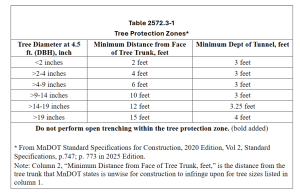
The University of Minnesota Extension emphasizes that older, large trees are far more vulnerable to infringement into their critical root zone.
The MnDOT Standard Specifications for Construction also specifies procedures for dealing with tree roots. Specifically, the standard states:
“Immediately and cleanly cut damaged and exposed roots. Cut back damaged roots of trees designated for protection to sound healthy tissue and immediately place topsoil over the exposed roots. Immediately cover root ends exposed by excavation activities with 6
inches of topsoil as measured outward from the cut root ends…Limit cutting to a minimum depth necessary for construction. Use a vibratory plow, or other approved root cutter in accordance with the Standard Detail Sheet for Protection and Restoration of
Vegetation, before excavation.” (2020 Edition, p. 746-747; 2025 Edition, p. 772.)
The MnDOT’s construction standards also provide specific directions when working near oak trees:
“Avoid wounding of oak trees during April, May, June, and July to prevent the spread of oak wilt. If the Engineer determines that work must take place near oak trees during those months, immediately (within 5 minutes) treat resulting wounds with a wound dressing
Material consisting of latex paint or shellac. Blend paint colors with the bark color. Maintain a supply of approved wound dressing on the Project at all times during this period.” (2020 Edition, p. 747; 2025 Edition, p. 773.)
The MnDOT Standard Specifications for Construction further specifies watering procedures for root-damaged trees.) Specifically, the standard states:
“Water root-damaged trees during the growing season that root damage occurs, and water Specified Trees… Maintain adequate but not excessive soil moisture by saturating the soil within the undisturbed portion of the dripline of impacted or identified trees to a depth of 20 inches. Use a soil recovery probe to check the soil moisture to a depth of 20 inches, and adjust the intervals and frequency of watering in accordance with prevailing moisture and weather conditions.” (2020 Edition, p. 747; 2025 Edition, p. 772)
The MnDOT Standard Specifications for Construction also states that fencing is required to “ensure the fence prevents traffic movement and the placement of temporary facilities, Equipment, stockpiles, and supplies”6 do not compact the soil around trees.
Clearly, significant effort is required to prevent tree failure when roots in the “tree protection zone” have been cut or damaged. Given the age and size of trees along Summit Avenue, the tolerance for critical root zone infringement is extremely low and if/when it occurs,
preventing tree failure is very time consuming and expensive.
Furthermore, empirical research shows that within 5 years of when a tree experiences nearby construction and/or repair work, it is more than twice as likely to topple during windstorms and gusts.7 In a study of tree loss after a windstorm in Minneapolis, the authors state:
“Damage to urban trees can begin with wind speeds as low as 25 miles per hour, especially when those trees harbor defects that predispose them to structural failures”.8 The researchers are referring to defects that are a result of damage to roots due to sidewalk repair. Examination of data over a 20-year period of the cause of trees that fell during a windstorm indicated that about 60% of the downed trees had evidence of trenching nearby.9
Winds in Minnesota and St. Paul typically and frequently exceed 30 mmiles per hour. An AI Google Gemini search revealed a) wind events are most frequent during spring (March-April) and fall (October-November), and b) on average, wind gusts over 40 mph occur 3-4 days in
winter alone. In addition, climate data from the Minnesota Department of Natural Resources indicate that 35-mile per hour winds have increased in frequency in Minnesota over the last few years, and its climatologists report that this trend is likely to continue. In short, Minnesota experiences frequent windstorms and gusts that significantly exacerbate the probability of tree failure. Trees are susceptible to toppling due to winds of even 25 miles per hour which are very common events every year in Minnesota. The Summit Avenue tree canopy will be more vulnerable to windstorms due to the compromised root systems of hundreds of trees damaged by the proposed reconstruction of Summit Avenue.
In short, one of the most important factors in whether a tree survives beyond the initial construction or repair work is damage to its critical root zone. Tree health, hence, tree longevity, is compromised. The tree is more susceptible to insect infestation, and the odds of it being
uprooted during a windstorm are more than double that of trees that have not experienced nearby repair work. The importance of the health and wellbeing of the structural root system cannot be overemphasized. Even minimal incursion into the root structure of mature trees is detrimental to tree longevity.
Estimating the number and percent of trees likely to be lost during and shortly after construction. Using a handful of examples of prior reconstructions that did not involve changing the curbs, the City of St. Paul estimates that 221 trees of the approximately 1,561 or approximately 14 percent of trees currently lining Summit Avenue would be lost or highly vulnerable to loss due to reconstruction of Summit Avenue. The City also estimates that without a bike trail, reconstruction of the street would still put 132 trees at high vulnerability.10 The City’s extrapolation from other dissimilar projects that were substantially less invasive into tree root systems underestimates the likely loss of trees due to the reconstruction work. Based on analysis performed by two independent arborists11 and extrapolating from their actual measured data on Summit Avenue, we can estimate that about two-thirds, or approximately a thousand,
trees along Summit Avenue, ultimately would be sacrificed if the street were fully reconstructed to build a bike trail.
Amount of Decrease in Property Values Due to Tree Loss
Trees increase property values, and the loss of tree Trees increase property values, and the loss of trees decreases property values. The loss
of a single tree results in .45% decrease in property value. However, a loss of 7% in tree canopy cover results in 7% loss in property value.12 Real estate experts estimate that a mature tree near a home increases its value 3% to 15%.13
Value of Physical Structures on Summit Avenue
Number of structures. According to Microsoft’s artificial intelligence tool, Copilot, there are 582 parcels including single-family homes, multi-unit buildings, and condos on Summit Avenue as well as tax-exempt parcels such as religious organizations and academic institutions. Of the 582 total number of properties, roughly 560 to 575 are taxable properties.14 The midpoint of that number is 568, so for purposes of discussion we can approximate that 568 properties on Summit Avenue pay property taxes.15
Market value of properties on Summit Avenue. The average market value of single-family homes, units in multi-unit buildings, and condos on Summit Avene is $770,000 but with a very wide range of values, i.e., from a few hundred thousand to a several million dollars.16 The total value of tax-paying properties on Summit could be reasonably estimated at $437,360,000. Google AI Gemini estimates the value of Summit Avenue properties at between 400 to 600 million dollars. To be conservative and avoid any impression of an exaggerated figure, we use $400,000,000.
II. Effect on Summit Avenue Property Values Due to Tree Loss – A Conservative Estimate
Summit Avenue properties will experience very significant decrease in their value due to tree loss. These losses are significant even using the City’s unrealistically conservative estimate of likely tree loss.
Estimate of Overall Decrease in Value of Summit Avenue Properties
Analyses using the information described in prior sections enable estimates of the loss of property values to be calculated. The following data were used to estimate the decrease in Summit Avenue property values:
a) Although the City estimates 221 trees (or 14% of all trees on Summit Avenue) will be lost, a very conservative number as explained above, we use a 7% loss of tree canopy for reasons described below.
b) Empirical research that documents a 7% loss in tree cover decreases property values by about 7%.17 The City’s 14% estimate of loss of trees on Summit Avenue includes some not-yet-mature trees. Thus, we use a very conservative estimate of 7% canopy loss to calculate loss in property values.
c) We also calculate the loss in property values using the City’s conservative estimate of a 14% loss of tree canopy. (Respected authorities estimate a much higher percentage of tree canopy loss due to the City’s proposed reconstruction of Summit Avenue.)
d) Total value of tax-paying properties on Summit Avenue of approximately $400 million, again a conservative estimate as described in prior sections.
Using these data, a very conservative estimate of the overall loss in value of Summit Avenue properties is approximately $28 million, i.e., ~$400,000,000 multiplied by .07 =$28,000,000. Using the City’s conservative estimate of 14% loss in tree canopy, the overall loss in value of Summit Avenue properties is $56 million, i.e., ~$400,000,000 multiplied by .14 =$56,000,000.
Estimate of Loss of Individual Property Owner Property Values
Assuming approximately 568 properties pay property taxes on Summit Avenue (see data in previous sections), we can approximate the average dollar amount of loss to individual property taxpayers on Summit Avenue. Using the overall loss in value and the number of
taxpayers, it is a simple mathematical calculation. The result is
- Roughly $50,000 loss to the average property taxpayer on Summit Avenue using the very conservative estimate of 7% tree canopy loss.
- Roughly $100,000 loss to the average property taxpayer on Summit Avenue using the City’s conservative estimate of 14% canopy loss.18
In addition, the City will assess on average approximately $20,00 to $40,000 per property owner on Summit Avenue to help pay for the reconstruction of Summit Avenue.19 Using the midpoint of the City’s expected assessment, i.e., $30,000, the following financial losses are
likely:
- On average, a very conservative estimate of the potential negative economic impact to the individual Summit Avenue property owner will be about $80,000.
- Using the City’s conservative estimate of 14% tree canopy loss, the total cost to the individual Summit Avenue property owner will be about $130,000.
These are costs that property owners on Summit will bear to accommodate building a separated, raised bike path that less than 1% of the citizens are likely to use.
Estimate of Loss to City in Property Tax Revenue and Other Costs
The City taxes residential properties at the tax rate of 1.27%. As a result of lower property values, the City will experience a decrease in property tax revenue.20
- The City’s loss in tax revenue is about $350,000 per year using the very conservative estimate of 7% loss in tree canopy.
- The City’s loss in tax revenue is about $700,000 per year using the City’s conservative estimate of 14% loss in tree canopy.
More specifically, assuming the very conservative 7% loss in tree canopy, $28,000,000, i.e., total loss in property value, multiplied by .0127 is $388,813, rounding down is $350,000 every year. Or, using the City’s conservative estimate of 14% tree canopy loss, $56,000,000 multiplied by .0127 equals $711,200 or roughly a $700,000 loss in tax revenue every year. This loss in tax revenue to the City will not occur quickly, as specific valuations will vary, and it will take time for the market to reflect the impact of losing ~1000 trees on Summit, but over the course of time adjustments in property values will occur. With the loss of its historic designation and the high taxes (both property and sales) in St. Paul, Summit Avenue is at risk of experiencing a serious decline in value, and the corresponding loss to the City’s tax base, similar to what it experienced in the 1950s.
Furthermore, the trees, as described above, will be more susceptible to the ravages of windstorms. The downed trees and branches will also lead to more power outages and damage to utilities as well as more repair costs for the city and individual property owners.
Conclusion
Both the community and the City will experience very serious financial consequences due to a full reconstruction of Summit that includes a separate, raised bike path.
III. Effect on Environment and Human Health Due to Tree Loss
Trees are regarded by environmentalist as “Superheroes”21 for good reason. Trees remove pollutants from the air, produce oxygen, cool the air temperature, absorb rainwater (helping prevent flooding of storm sewers and basements), increase biodiversity, and combat urban heat island effects to name a few of the beneficial environmental effects of trees, especially mature trees with their large canopies and root systems.22 The cumulative research evidence for these effects is solid and difficult to dispute. Trees also improve the health of humans, both psychological and physical health. Again, the research is solid as described below and well accepted.
Environmental Benefits of Trees
A single mature tree typically removes 20 to 50 pounds of carbon dioxide (CO2) per year depending upon the species and site conditions. A mature tree also absorbs meaningful amounts of several other harmful pollutants including nitrogen dioxide (NO2), sulfur dioxide (SO2) and ozone (O3) as well as particulate matter (i.e., PM2ֹ 5 and PM10).23 In lay terms, 2 to 4 mature leafy trees produce as much oxygen as one person needs in a year.”24
Shade from tree canopy reduces energy costs for citizens and the City through natural cooling that results in lower energy use and cost.25 Empirical research indicates that one additional percentage point of tree cover translates into approximately 2.5% reduction in energy
consumption.26 Lowering the temperature in a building by one degree changes energy consumption anywhere between 1-8% depending upon outside temperature and insulation.27 According to the Metropolitan Council: “Trees reduce air temperatures by up to 10 degrees
through shade and evapotranspiration, while also improving air quality, managing stormwater, and providing crucial wildlife habitat.” Trees are instrumental in combating the effects of urban heat islands.
The City recognizes the benefit of trees. The Department of Parks and Recreation’s website contains a report entitled “Saint Paul, Minnesota Urban Canopy Assessment, 2012” that reports the energy reduction/savings, carbon sequestered, total carbon stored, air pollutants removed, air pollutants avoided, stormwater runoff avoided, and other benefits for each of the 17 districts in St. Paul.28 The City plainly understands and acknowledges the value of trees to the environment and the City. The City has offered no explanation for their silence on this issue in the context of SART.
Psychological and Physical Effect of Trees on Human Health
Trees have significant benefits to human health. The research is strong, varied, and replicable. Indeed, meta-analyses that combine multiple studies examining the same phenomenon exist and support the positive and significant effects of trees on the psychological
and physical effects on humans. A few of the effects of mature trees are:
- Fewer drug prescriptions for mood disorders and cardiovascular disease.29
- Lower psychological distress.30
- Lower incidence of diabetes, hypertension and cardiovascular diseases.31
- Better sleep.32
- Reduced risk of cardiovascular disease and fewer deaths due to illnesses of the lower respiratory system and cardiovascular events.33
- Less attention fatigue, thus improving focus, competence, and quality of life.34
The benefits of mature trees to human health, both psychological and physical, are significant and they are many. Trees are worth preserving and maintaining. Clearly, preservation of trees is important, especially when non-invasive, tree-preserving, alternative designs and construction methods exist.
IV. Effect on Historic Character of Summit Avenue
Summit Avenue is now regarded as the “best preserved avenue of Victorian architecture in the country.” According to Bolton & Menk, the trees on Summit Avenue are a defining element of the historic district. The avenue will be without many of its large, beautiful, mature
trees and the addition of a separated, raised bike path will not be historically correct. The storied avenue will lose much of its historic value and charm for people walking the street as well as tourists.
V. Final Thoughts
The Metropolitan Council espouses the benefits and importance of urban tree canopy. Robert Lilligren, Chair of the Metropolitan Council’s Community Development Committee, said: “Trees are one of the smartest long-term investments we can make for our region’s future.
They’re part of a natural system that cleans our air, cools our neighborhoods, prevents erosion, and creates the beautiful, livable communities we all want to call home.”35 One of the rationales for building a raised, separated bike path that requires reconstructing Summit Avenue is supposedly to promote a carbon-free transportation mode, i.e., biking. It is ironic that such reconstruction will destroy hundreds of trees – the very trees that environmentalists refer to as superheroes. Similarly ironic is the Metropolitan Council’s rubber stamping of the City of St. Paul’s Summit Avenue Regional Path plan of 2023 without any critical assessment of the concerns that were raised, a plan that will result in the destruction of hundreds of trees.
The Minnesota Department of Natural Resources (DNR) mission is to “work with Minnesotans to conserve and manage the state’s natural resources…” of which trees are a critical component. Its Urban & Community Forestry programs emphasize preserving mature trees
because they provide the most tree canopy benefits.36 “The DNR does not only want to plant new trees but also develop methods to maintain the current canopy.”37 Tree planting is important, but it is just one part of canopy stewardship. Similarly, the Minnesota Pollution Control Agency in its 2017 Adapting to Climate Change in Minnesota report stated that its focus is to “reduce urban
heat island and other climate impacts through approaches that will preserve and expand tree canopy…”38
The DNR now has a Community Tree Canopy Viewer that is designed to help communities maintain tree canopy, not just plant them. Its “Rapid Assessment Community Tree Report Viewer” shows that from 2013 to 2023 the number of trees in Ramsey County increased but the tree canopy decreased.39 Why? Because mature trees, the ones that provide the greatest
benefits, were lost often due to public policies that removed mature trees and replaced them with
saplings – exactly what the city’s 2023 SART reconstruction of Summit Avenue will do.
The importance and value of trees is well documented and well understood. The City of St. Paul’s website acknowledges this as well. In the City’s words: “Trees are our largest source of green infrastructure and enhance the landscape by providing shade to homes, roads and parking lots, and provide color, beauty and character to the community. Trees also provide benefits behind the scenes, such as the interception and storage of rainwater and carbon, the reduction of noise pollution, and have proven to reduce crime and stress.”40 These are but a few of the myriad significant even life-altering benefits of trees.
Former St. Paul Mayor Coleman proposed a bike plan in 2015. It emphasized expanding the number of on-street bike paths, and it focused on “…the development of effective bicycle infrastructure in a cost-effective manner”41 without sacrificing trees. Mayor Carter’s 2023 bike
plan, in particular SART with its off-street design, will instead destroy hundreds of trees, many of them mature trees, and cost the citizens of St. Paul 50 times more per mile just to build than an “in-street separated lanes” design. Furthermore, the SART off-street design will cost about twice as much per mile to maintain.42 We need a new city-wide bike plan, a Mayor Her bike plan that is cost-effective, serves all of St. Paul, and respects the benefits and value of trees.
Trees are indeed superheroes with life-altering benefits. We must do all we can to preserve them. We need a “tree-first” culture.
Notes
1 The body of the report provides the citations that document and support this and the following statements.
2 Bikers likely to use the bike path represent perhaps less than 1% of the City’s population. Furthermore, as the state demographer, Susan Brower, reported to the City Council on July 16, 2025, the population of Saint Paul (and Minnesota) is aging, and Ramsey County is experiencing population loss. Conclusion: Fewer citizens will be living in Saint Paul and more of them will be over 65 years old. This means that even fewer people are likely to be biking Summit Avenue in the future, and more of them might be walking. It raises the question of the value to the City’s citizens of spending $100+ millions of their assets to undertake such a project with such questionable merit as the
analyses in this report indicate.
3 https://www.planning.org/greatplaces/streets/2008/summitavenue.htm; https://www.twincities.com/2008/10/07/national-planning-group-taps-summit-avenue-as-a-great-street/
4 City of Saint Paul is trying to increase tourism and make Saint Paul a destination of choice. Destroying the historic character of Summit Avenue does not help this effort.
5 See Woodwell Climate Research Center; Google AI search; Microsoft Copilot AI search
6 MnDOT Standard Specifications for Construction, 2020 Edition, p. 746; MnDOT Standard Specifications for Construction, 2025 Edition, p. 772.
7 Johnson, G., Giblin, C., Murphy, R., North, E., & Rendahl. (2019). Boulevard tree failures during wind loading events. Arboriculture & Urban Forestry, 45, 259-269.
8 Ibid, p. 259.
9 Moore, G.M. (2014). Wind-thrown trees: Storms or management? Arboriculture & Urban Forestry, 40 (2), 53-69.
10 McClure, J. (2023). Saint Paul approves raised, separated bike trail on Summit Avenue. Monitor – Midway, Como, Frogtown.
11 Summit Avenue Tree Survey, Nov.11, 2022 by Trees & Me, LLC, Chad P. Gilbin, MS and Manuel Jordan.
12 Han, L., Heblich, S., Timmins, C., & Zylberberg, Y. (in press). Cool cities: The value of urban trees. American Economic Review: Insights. See also: Druckenmiller, H. Estimating an economic value of forests: Evidence from tree mortality in the American West. Technical Report 2023. Kovacs, K., Holmes, T., Englin, J., & Alexander, J. (2011, July). The dynamic response of housing values to a forest invasive disease: Evidence from a sudden oak death infestation,” Environmental & Resource Economics, 49 (3), 445–471.
13 Vagkucam, S., (2026). The root of maintenance. Column in New York Times dated March 15, 2026. Reprinted in Minneapolis Star & Tribute, March 15, 2026.
14 Microsoft Copilot AI search, March 16,2026.
15 Midpoints and rounding conventions as well as conservative estimates are used throughout this report to avoid the appearance of overstating the impact that full construction will have on the environment, the public and the City.
16 Microsoft Copilot AI search, March 16,2026.
17 Han, L., Heblich, S., Timmins, C., & Zylberberg, Y. (in press). Cool cities: The value of urban trees. American Economic Review: Insights.
18 Specifically, using the very conservative estimate of 7% canopy loss, $28,000,000 total property value loss divided by 568 (the number of property taxpayers) equals $49,296 or roughly $50,000 loss in property value for the average taxable property. Using the City’s conservative estimate of 14% canopy loss, the average loss in property value doubles to almost $100,000 (i.e., $56,000,000 divided by 568 equals $98,592).
19 Preliminary estimates by the City regarding funding sources for reconstructing Summit Avenue have estimated aggregate assessments to property owners for Segment 1, Mississippi River Boulevard to Fairview, of $2.85 million. (See https://www.stpaul.gov/sites/default/files/2025-08/2026%20Proposed%20CIB%20Budget-%20City%20of%20Saint%20Paul.pdf) The number of properties from the Mississippi River Boulevard (MRB) to Fairview is 92 with about 17 non-profits for a total of 75 tax paying properties, i.e., $2,850,000 ÷ 75 = $38,000 (number of properties obtained from Ramsey County Tax records).
20 Objective data would conclude that property values will be lower because of tree loss. The decrease in property tax revenue to the City will be true if the City accurately reflects market values in its determination of property values.
21 See World Wildlife Fund (WWF), The Nature Conservancy, Good Earth Plants, Bow Seat Ocean Awareness Programs, and Good Earth Plants websites.
22 See Minnesota’s DNR Division of Forestry website, especially “Trees and forests” and “Tree benefits.”
23 Google Gemini and Microsoft Copilot AI searches.
24 Microsoft Copilot AI search.
See also:
Helmenstine, A. M. (2019, November). How Much Oxygen Does One Tree Produce? Stancil, J. M. (2015, March). The Power of One Tree – The Very Air We Breathe. U.S. Department of Agriculture. Villazon, Luis. How many trees does it take to produce oxygen for one person? BBC Science Focus Magazine.
25 Metropolitan Council bulletin sent 6/30/2025; Metropolitan Council NEWS.
26 Han, L., Heblich, S., Timmins, C., & Zylberberg, Y. (in press). Cool cities: The value of urban trees. American Economic Review: Insights.
27 Google Gemini AI search.
28 Saint Paul Department of Parks and Recreation-Forestry Unit. (2011). Saint Paul, Minnesota Urban Canopy Assessment. Saint Paul Parks and Recreation. See also the Oklahoma State Division of Agricultural Science and Natural Resources website.
29 Chi, D., Aerts, R., Nieuwenhuyse, A. V., Bauwelinck, M., Demoury, C., Plusquin, M., Nawrot, T. S., Casas, L., & Somers, B. (2022). Residential exposure to urban trees and medication sales for mood disorders and cardiovascular disease in Brussels, Belgium: An ecological study. Environment Health Perspectives, 130 (5), 1-10. (https://doi.org/10.1289/EHP9924).
30 Astell-Burt, T., & Feng, X. (2019). Association of urban green space with mental health and general health among adults in Australia. JASMA Network Open 2(7):e198209, PMID: 31348510. (https://doi.org10.1001/jamanetworkopen2019.8209).
31 Astell-Burt, T., & Feng, X. (2020). Urban green space, tree canopy and prevention of cardiometabolic diseases: a multilevel longitudinal study of 46,786 Australians. International Journal of Epidemiology, 49 (3):926-933, PMID: 31722373 (https://doi.org/10.1093/ije/dyz239).
32 Ibid.
33 Donovan, G. H., Butry, D. T., Michael, Y. L., Prestemon, J. P., Liebhold, A. M., Gatziolis, D., Mao, M. Y. (2015). Is tree loss associated with cardiovascular-disease risk in the Women’s Health Initiative? A natural experiment. Health Place, 36:1-7, PMID: 26335885 (https://doi.org/10.1016/j.healthplace.2015.08.007). Donovan, G. H., Butry, D. T., Michael, Y. L., Prestemon, J. P., Liebhold, A. M., Gatziolis, D., Mao, M. Y. (2013). The relationship between trees and human health: evidence from the spread of the emerald ash borer. American
Journal of Preventive Medicine, 44 (2):139-145. PMID:23332329, https://doi.org/10.1016/j.amepre.2012.09.066).
34 Kaplan, S. (2002). Some hidden benefits of the urban forest. Selected Conference Papers – Forestry Serving Urbanised Societies, Copenhagen, Denmark, pp. 221-231).
35 Metropolitan Council bulletin sent 6/30/2025; Metropolitan Council NEWS.
36 https://www.dnr.state.mn.us/forestry/urban/index.html; https://www.dnr.state.mn.us/forestry/urban/community-tree-canopy.html; https://www.dnr.state.mn.us/news/2026/04/06/dnr-launches-first-its-kind-online-tree-canopy-mapping…; https://ww.dnr.state.mn.us.
37 Minnesota ramps up statewide push to expand tree shade in urban heat islands. The Minnesota Star Tribune. April 29, 2026.
38 www.pca.state.mn.us, document number p-gen4-07c.
39 https://www.dnr.state.mn.us/forestry/urban/community-tree-canopy.html.
40 Website: Saint Paul Minnesota; Parks & Recreation; Forestry (https://www.stpaul.gov › departments › parks-and-recreation › forestry › urban tree canopy assessment); accessed March 15, 2026.
41 Carter Bike Plan: https://www.stpaul.gov/sites/default/files/2024-05/2024%20Saint%20Paul%20Bicycle%20Plan-for%20web.pdf; Coleman Bike Plan: https://learn.sharedusemobilitycenter.org/wp-content/uploads/policy-documents-3/MN_Saint%20Paul_Bicycle-Plan_201504091632030119.pdf.
42 The 2015 Coleman Bike Plan included a chart comparing the cost of different types of bike paths, both for construction and for maintenance.
© Leaetta Hough, 2026. All rights reserved.

Leave a Reply